
Terrena: A World Born from a Quantum ComputerThe birth of a planet, from the Big Bang to the year 2617
▶ Birth of Terrena, 86 s, silent. Every stage is a procedural visualization driven by the quantum seed: the real Tuna-17 bitstrings, then the Big Bang, the CMB, the cosmic web, the galaxy, the star Kestrel, the disk, the young planet, life and, finally, the civilization of 2617.
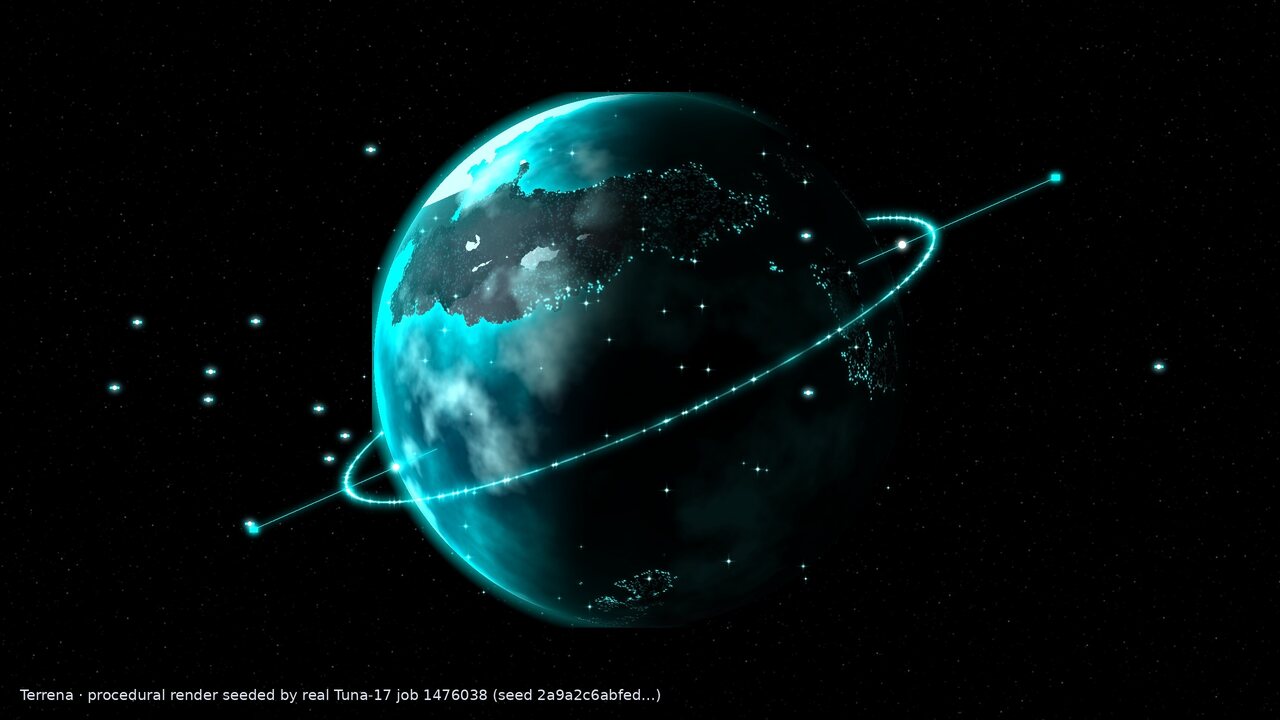
A new world, 1.03 Earths in mass, under a Sun-like star, drawn from 1,024 quantum measurements.
How this was made
- Real Quantum job. The circuit put a Hadamard gate on all 17 qubits of Tuna-17 and measured them. It ran 1,024 shots, and 1,017 of the bitstrings were unique.
- Real Seed. The sorted measurement counts were hashed with SHA-256 into one 256-bit seed: 2a9a2c6a…
- Simulated Classical simulation. The seed drove a NumPy random generator, which picked the cosmology, the galaxy, the star and the planet using textbook physics (a Friedmann integral, Kepler’s third law, habitable-zone fluxes and a mass-radius relation).
- Procedural Visuals. The video and renders were drawn from those parameters, and the glitter positions come straight from the shot bitstrings.
- Speculative Story. Life, the climate narrative and the civilization of 2617 are imaginative worldbuilding that stays consistent with the numbers. The cyan palette is an artistic choice.
Birth timeline
- Sep 26, 2026, 11:49:57 AM PT: the job is submitted RealThe job goes to Quantum Inspire Tuna-17 (job 1476038, batch 849438).
- 12:23:03 to 12:23:07 PM PT: the qubits are measured Real4.02 s of execution produce 1,024 shots, and SHA-256 turns them into the seed 2a9a2c6a…
- t = 0: Big Bang SimulatedA flat ΛCDM universe with H0 66.80, Ωm 0.316 and ΩΛ 0.684.
- ≈ 376,400 years: plasma cools and the CMB is releasedLight escapes at z ≈ 1088. Today the CMB glows at 2.729 K.
- 100 million to 1 billion years: cosmic web and first starsDark-matter filaments form, and the first stars ignite in the densest knots.
- ≈ 1 to 9.6 billion years: the galaxy formsA 2-arm spiral assembles, with about 127 billion stars across 103,000 light-years.
- 9.57 billion years: Kestrel is bornA molecular cloud collapses 23.48 thousand light-years from the galactic center and ignites an F9V star.
- 9.57 billion years (+ ≈ 10 million): proto-TerrenaPlanetesimals clump together near 1.13 AU, inside the habitable zone.
- 9.6 to 10.2 billion years: molten world, crust, then oceansA magma ocean cools into a basalt crust, and oceans rise to cover 64.7% of the surface.
- 10.6 to 13.91 billion years: atmosphere, clouds, life SpeculativeThe air settles at 1.028 bar of N₂ and O₂. Life colors the land dark teal.
- Year 2617 (local calendar, ≈ 13.91 billion years): civilization Speculative12.9 billion people, an orbital ring, space elevators and a fusion grid.
The simulated eras match the stages of the birth video, and each one is a procedural visualization driven by the seeded parameters.
How it compares
| Property | Terrena | Earth |
|---|---|---|
| Orbit | 1.125 AU | 1.000 AU |
| Sunlight received | 1.035× | 1.000× |
| Year | 421.4 days | 365.25 days |
| Day | 26.65 h | 24 h |
| Axial tilt | 23.7° | 23.4° |
| Mass | 1.032 M⊕ | 1 M⊕ |
| Radius | 1.009 R⊕ (6,426 km) | 6,371 km |
| Gravity | 1.014 g | 1 g |
| Density | 5.54 g/cm³ | 5.51 g/cm³ |
| Escape velocity | 11.32 km/s | 11.19 km/s |
| Ocean | 64.7% | 71% |
| Pressure | 1.028 bar | 1.013 bar |
| Air | N₂ 79.4% · O₂ 19.7% · CO₂ 345 ppm | N₂ 78.1% · O₂ 20.9% · CO₂ ≈420 ppm |
| Mean temp | ≈18 °C (291.4 K) | ≈15 °C |
| Moon | 1 · 332,609 km · 21.6 d | 1 · 384,400 km · 27.3 d |
| Property | Kestrel | Sun |
|---|---|---|
| Type | F9V | G2V |
| Mass | 1.07 M☉ | 1 M☉ |
| Luminosity | 1.31 L☉ | 1 L☉ |
| Radius | 1.056 R☉ | 1 R☉ |
| Surface temp | 6,011 K | 5,772 K |
| Age | 4.34 Gyr | 4.6 Gyr |
| Habitable zone | 1.14–1.57 AU (conservative) | 1.00–1.37 AU |
| Property | Terrena’s galaxy | Milky Way |
|---|---|---|
| Type | 2-arm spiral | barred spiral |
| Stars | ≈127 billion | ≈100–400 billion |
| Diameter | ≈103,000 ly | ≈100,000 ly |
| Home star from center | 23,480 ly | Sun: ≈26,700 ly |
| Property | Seeded | Ours (Planck 2018) |
|---|---|---|
| H0 (km/s/Mpc) | 66.80 | 67.4 |
| Ωm / ΩΛ | 0.316 / 0.684 | 0.315 / 0.685 |
| CMB today | 2.729 K | 2.7255 K |
| Age | 13.91 Gyr | 13.8 Gyr |
The quantum job Real
- Processor
- Quantum Inspire Tuna-17, superconducting, 17 qubits (real hardware)
- Circuit
- H on q[0]…q[16], then measure all (cQASM 3.0)
- Job / batch
- 1476038 / 849438
- Shots
- 1,024 (1,017 unique bitstrings)
- Submitted
- 11:49:57 AM PT, Sep 26, 2026
- Ran
- 12:23:03 to 12:23:07 PM PT (4.02 s execution)
- Seed (SHA-256)
- 2a9a2c6abfedd8403feffc2da789587014071b5f4483fa78a220a466aec66e8e
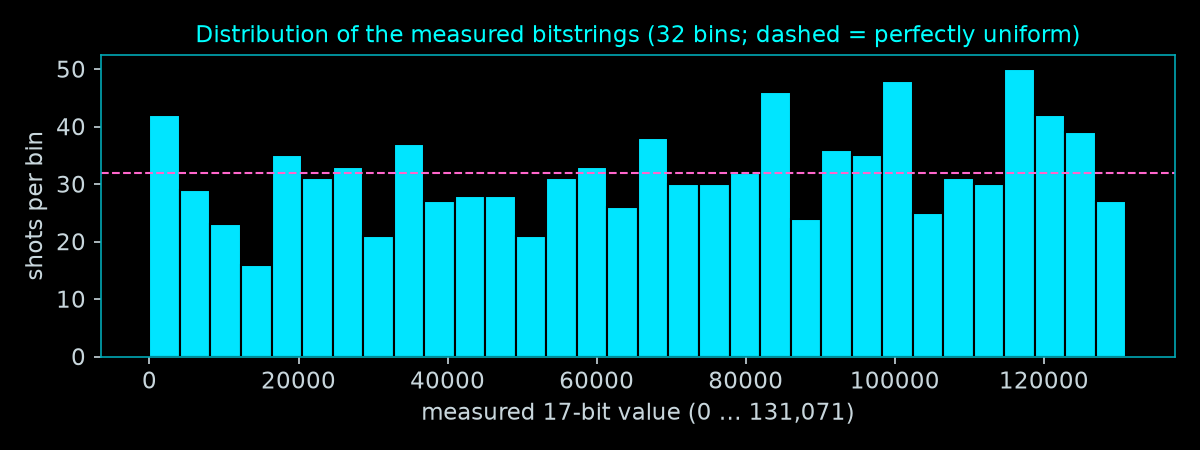
With 131,072 possible outcomes, a few repeats are expected by chance, which is what an ideal random source produces. The same counts always rebuild the same world.
Where is Terrena?
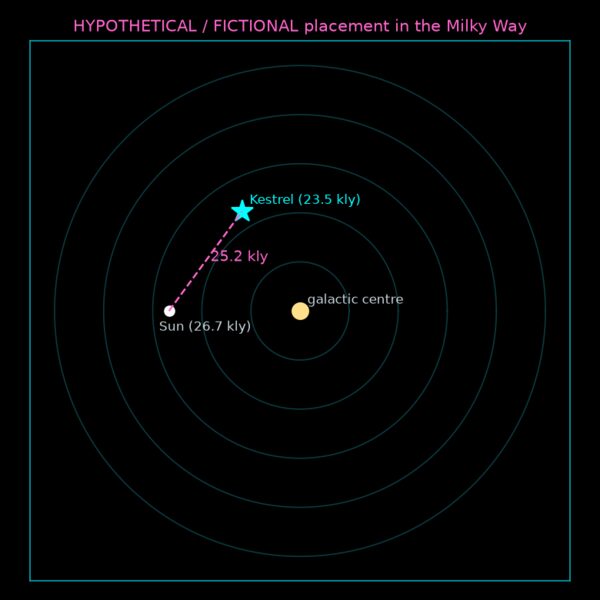
In its own universe: Terrena orbits the star Kestrel at 1.125 AU. Kestrel lies in a 2-arm spiral galaxy, 23,480 light-years from the center, about 45% of the way out, in the galactic habitable zone.
From Earth: there is no real distance. Terrena exists in a separate simulated universe, so no telescope could find it.
Hypothetical If its galaxy were the Milky Way, then with the seeded angle of 59.9° around the center, Kestrel would be ≈25,212 light-years from Earth.
| Traveler (fictional) | Time |
|---|---|
| Light or radio | 25,212 years |
| Ship at 10% of light speed | ≈252,000 years |
| Ship at 50% of light speed | ≈50,400 years (≈43,700 for the crew) |
Civilization in 2617 Speculative worldbuilding
In this story, Terrena’s 12.9 billion people live mostly in 115 coastal arcology cities. That leaves the dark-teal interiors rewilded, and at night the coastlines glow cyan. A 63-terawatt fusion grid powers an orbital ring 794 km up. Three space elevators rise from the equator through the ring to shipyards in synchronous orbit at about 39,300 km. The single large moon, 333,000 km out, holds the helium-3 refineries and deep-space telescopes.
The numbers were drawn from the same seed, and the narrative is fiction built around them.
The ten stages of the birth video
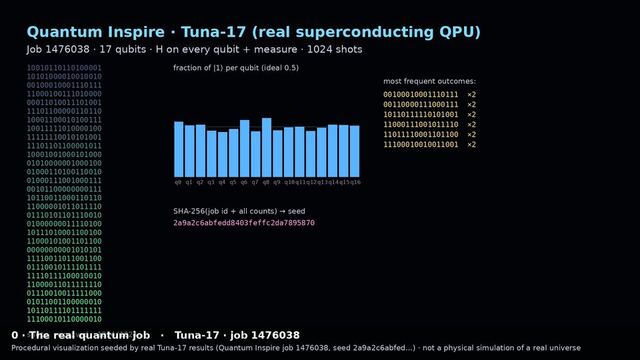
The real Tuna-17 bitstrings stream in, and the per-bit bars and the SHA-256 seed are computed from the actual counts.
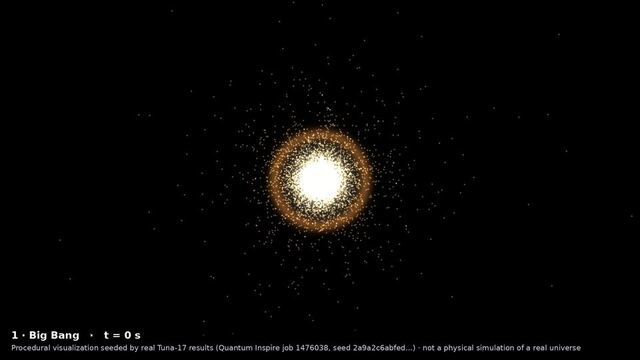
A bright point expands, and the seed sets the particle directions.
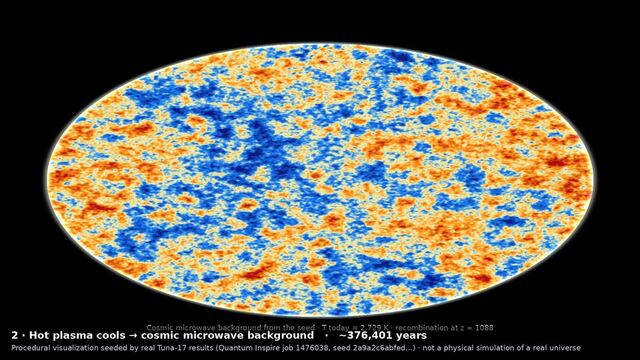
Light escapes at z ≈ 1088 and leaves a speckled, seeded CMB-like map. This is a procedural field, not real CMB data.
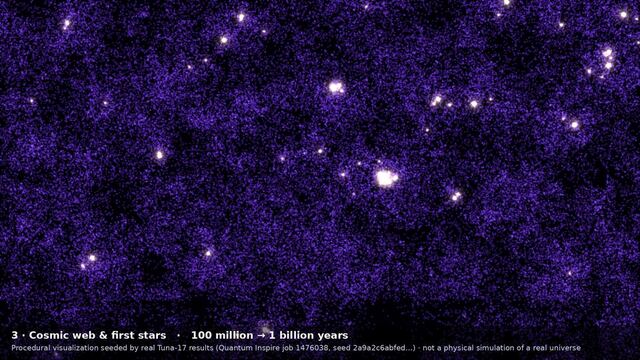
Dark-matter filaments form from a seeded density field (Zel’dovich approximation).
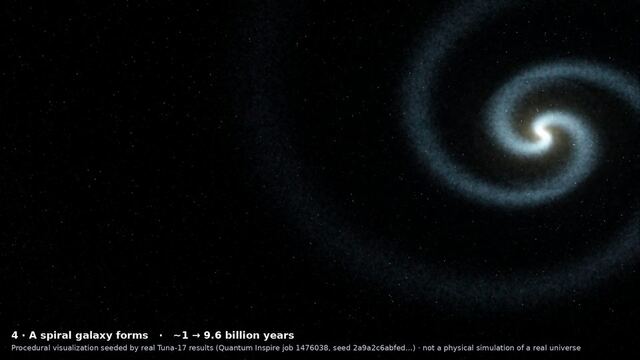
A 2-arm spiral with an 11.4° pitch assembles, and the camera zooms to 23.5 kly from the core.
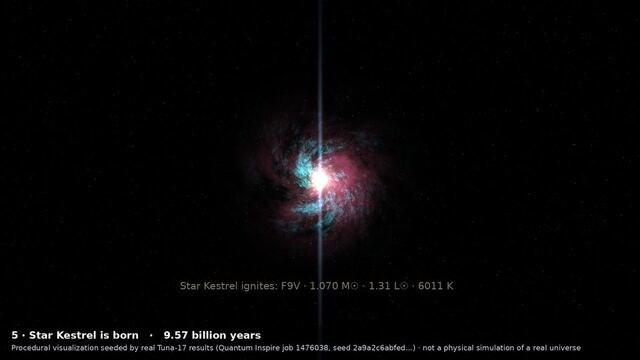
A molecular cloud collapses, and the protostar ignites and launches jets.
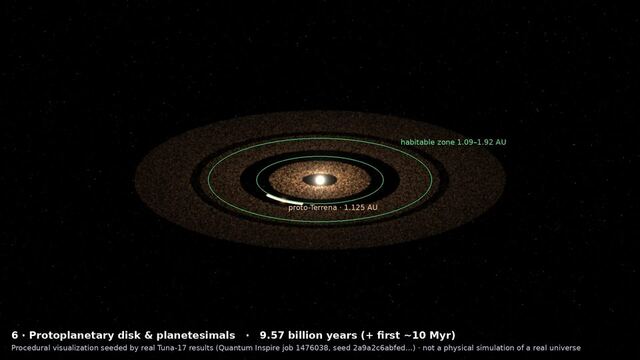
Planetesimals near 1.13 AU clump into proto-Terrena.
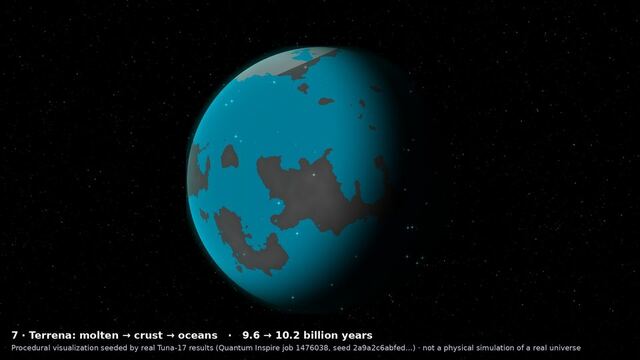
A magma ocean cools into a basalt crust, and oceans rise to 64.7% coverage.
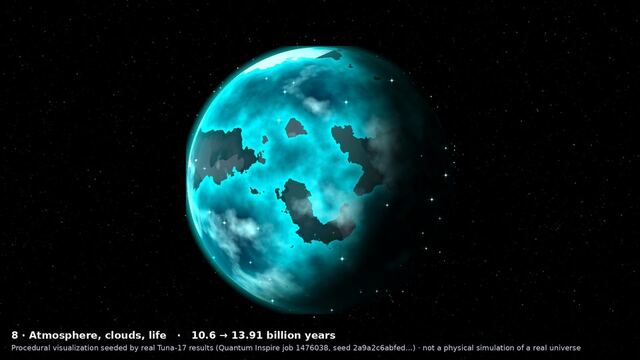
Clouds form, a cyan halo appears, and life colors the land dark teal.
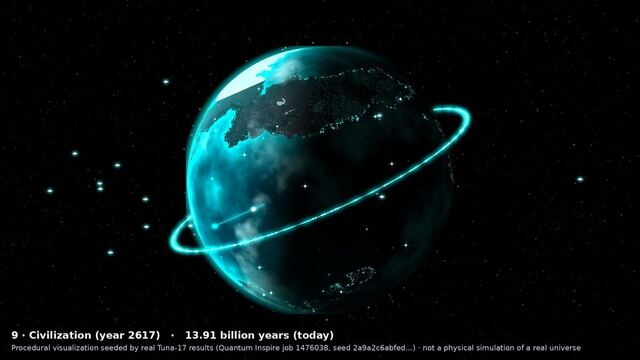
The night side shows cyan cities, the neon orbital ring and the elevators.
The measured bits Real data
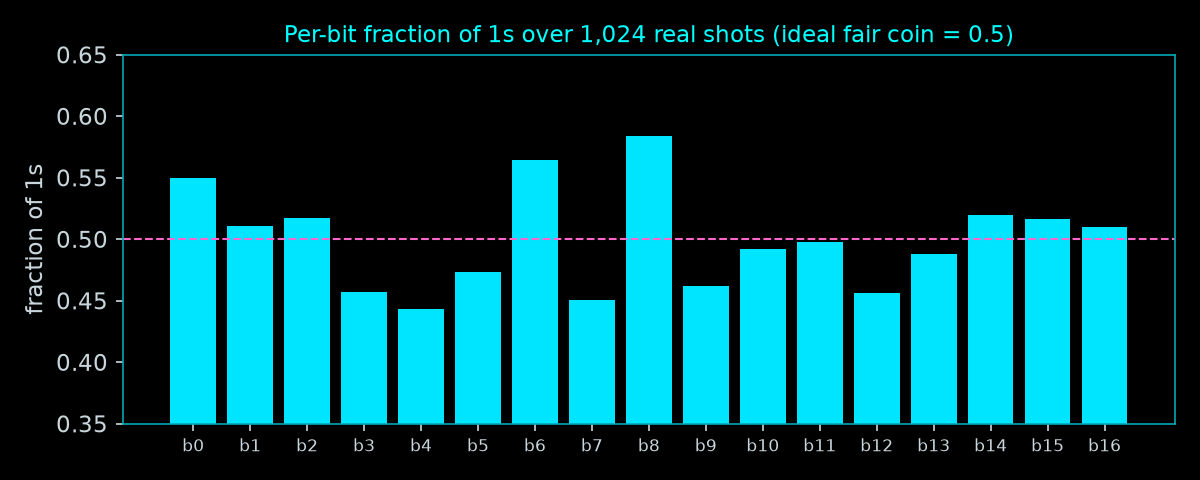
The first chart shows the fraction of 1s on each of the 17 qubits across the 1,024 real shots. Deviations of a few percent are normal readout bias on current noisy hardware, and SHA-256 mixes every bit, so the bias does not affect the seed. The second chart is a histogram of the measured 17-bit values. 7 bitstrings appeared twice, in line with an ideal uniform source.
Climate, geology and life Speculative worldbuilding
Climate. With 1.04 times Earth’s sunlight, a 23.7° tilt and a 421-day year, Terrena would have Earth-like seasons that each last about 15% longer. The 26.6-hour day would slightly soften the swing between day and night. A mean near 18 °C would suggest small polar caps and broad temperate zones.
Geology. At 1.03 Earth masses and 5.54 g/cm³, Terrena would plausibly have an iron core, a convecting mantle, plate tectonics and a magnetic field. Its large moon, which orbits closer in than ours, would raise strong tides and help stabilize the tilt.
Life. In this story, life begins in tidal shallows. Photosynthesis raises oxygen to the modeled 19.7%, and land plants use a teal-shifted pigment tuned to Kestrel’s slightly hotter light. The glowing cyan oceans are an artistic brand choice, not a physical prediction.
Methods and limits
Quantum The only thing the quantum computer contributed was the random seed, from real Tuna-17 hardware job 1476038. No emulator output was used.
Classical Python and NumPy with a PCG64 generator seeded by the SHA-256 digest, drawing values around those of the real universe. The age comes from a Friedmann integral. The star uses L ∝ M⁴ and R ∝ M0.8, with Kopparapu-style habitable-zone fluxes, a rocky mass-radius relation, Kepler’s third law, and an equilibrium temperature plus a simple greenhouse term.
Procedural A NumPy and Pillow renderer made the video and stills.
A 17-qubit processor cannot simulate physics at cosmic scale, and nothing here claims it did. The quantum job supplied true randomness, and everything else is transparent classical computation that anyone can rerun from the seed.
Mission 2: The City of Qirport and the NethraiQuantum-seeded worldbuilding, not observed
▶ Qirport city flyover, 38 s, silent. A procedural render whose towers and lights are placed by the mission seed.
▶ Mission 2 video, 78 s, silent. It covers the real job data, the city, the Nethrai and a fictional distance card.
Gallery Illustrations
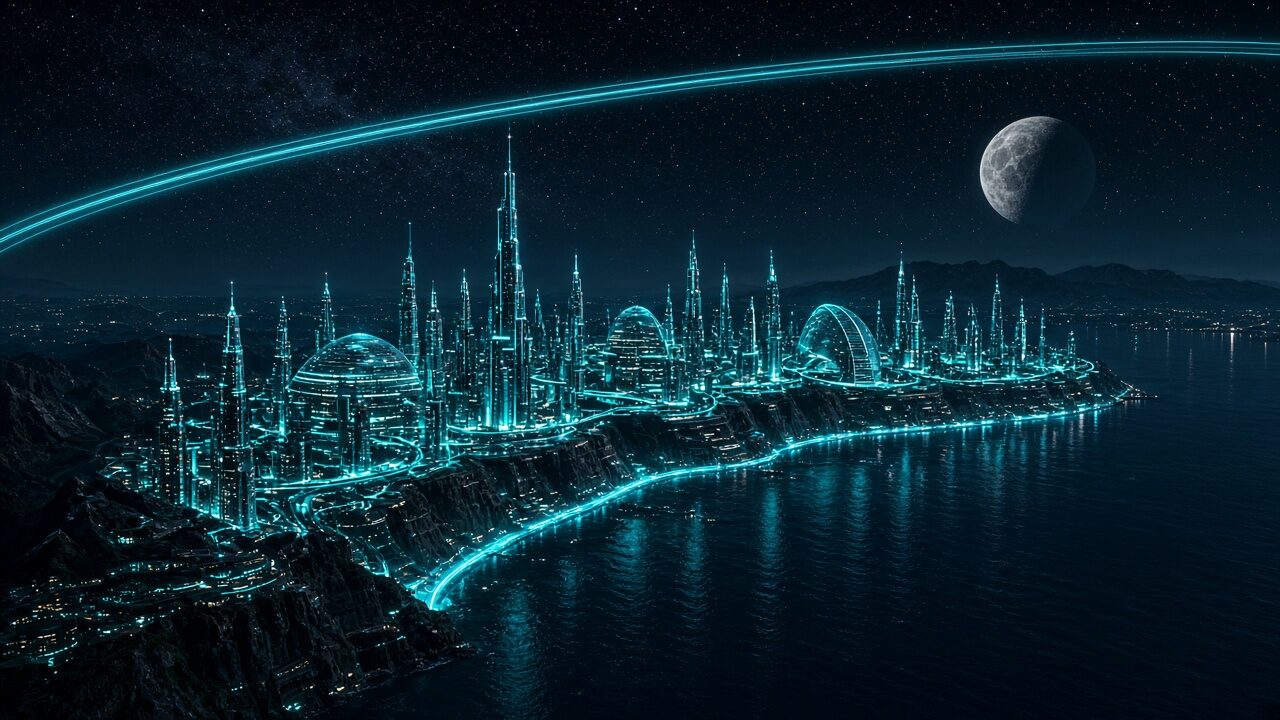
The terraced crescent city along the fjord coast, under the orbital ring.
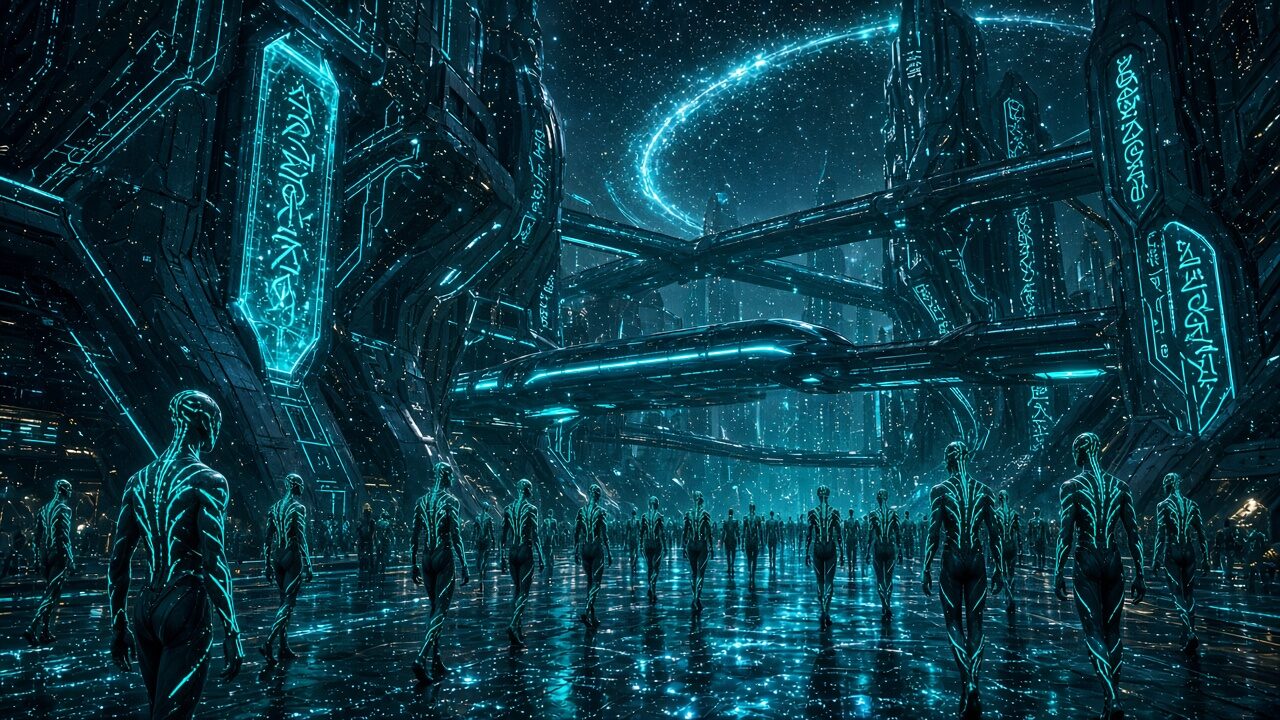
Crowds among the arcology towers and holo-signage.
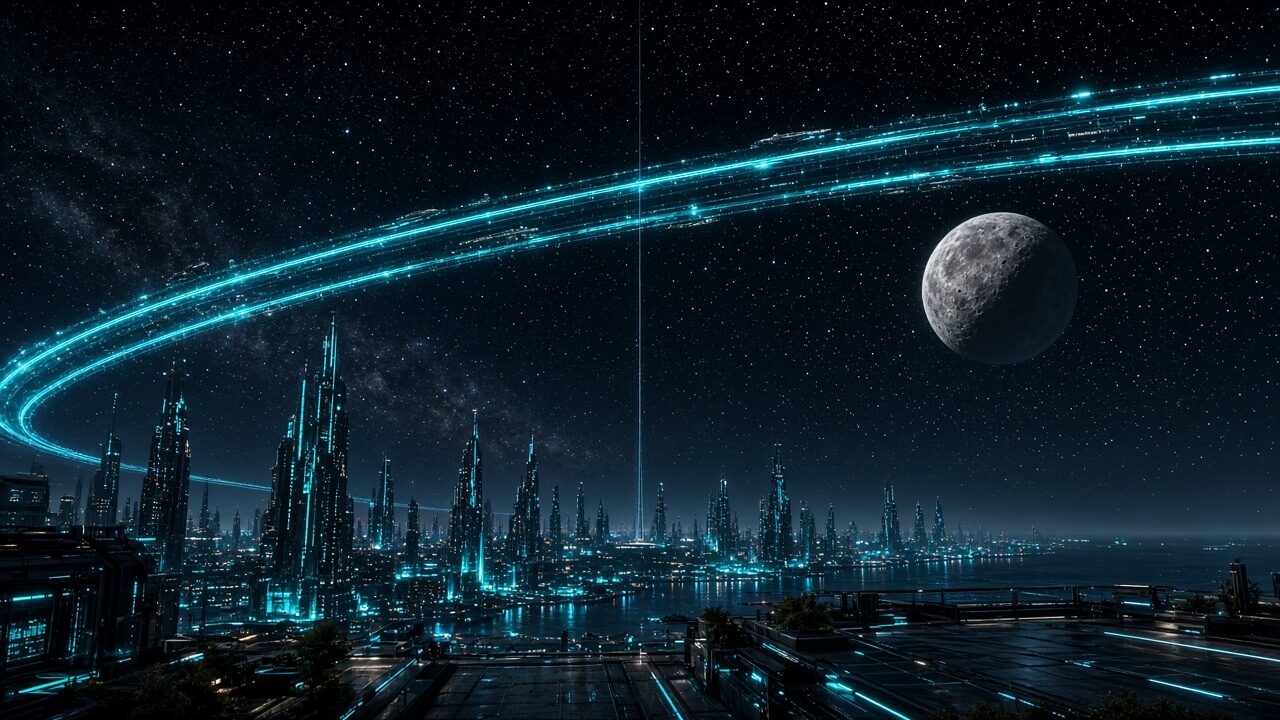
The ring arcs over the skyline, as seen from Zenith Plaza.
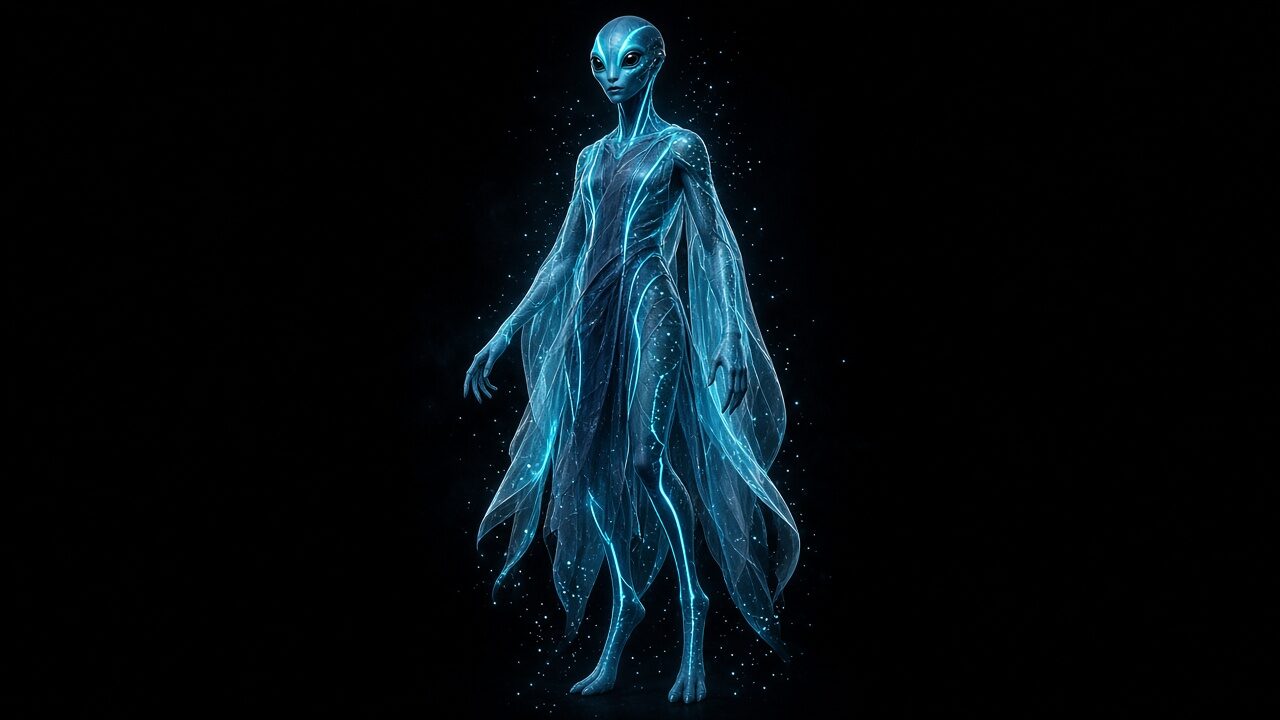
1.93 m, slender, digitigrade legs, light-fibre robes.
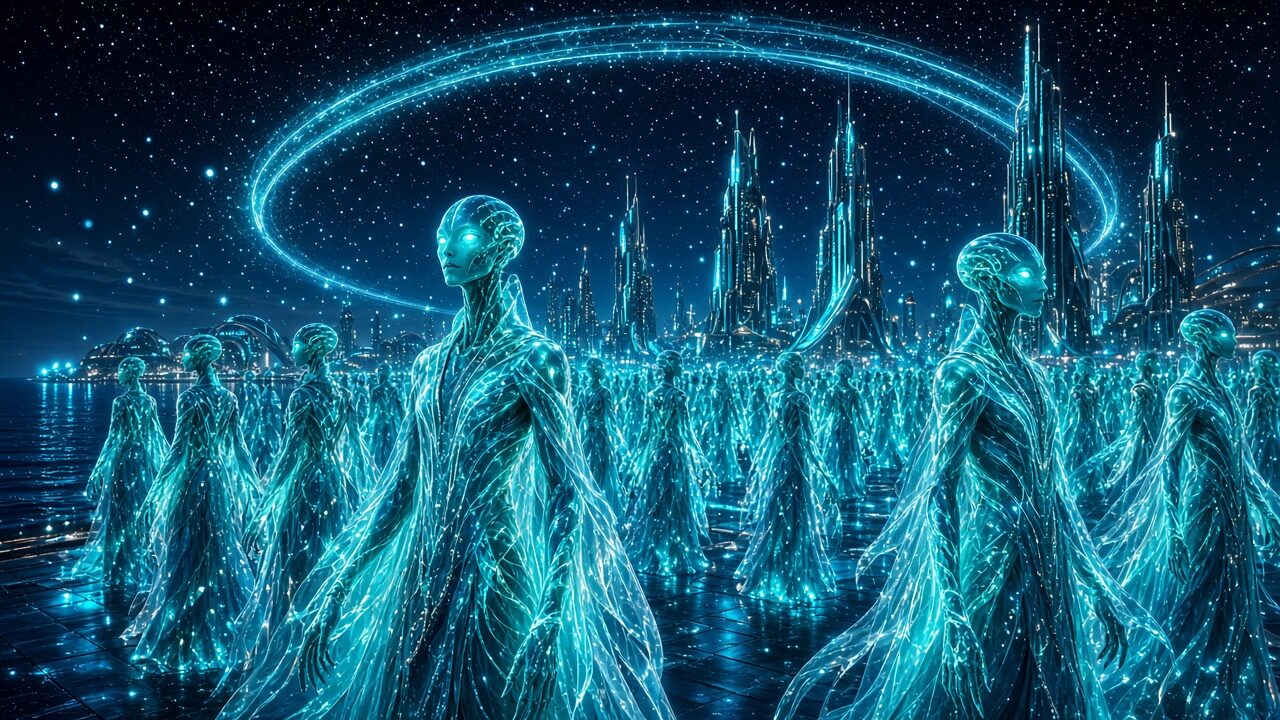
Nethrai gather as millions of photophores flash in unison.

Cyan-ringed eyes, twin glowing stripes, pearlescent deep-teal skin.
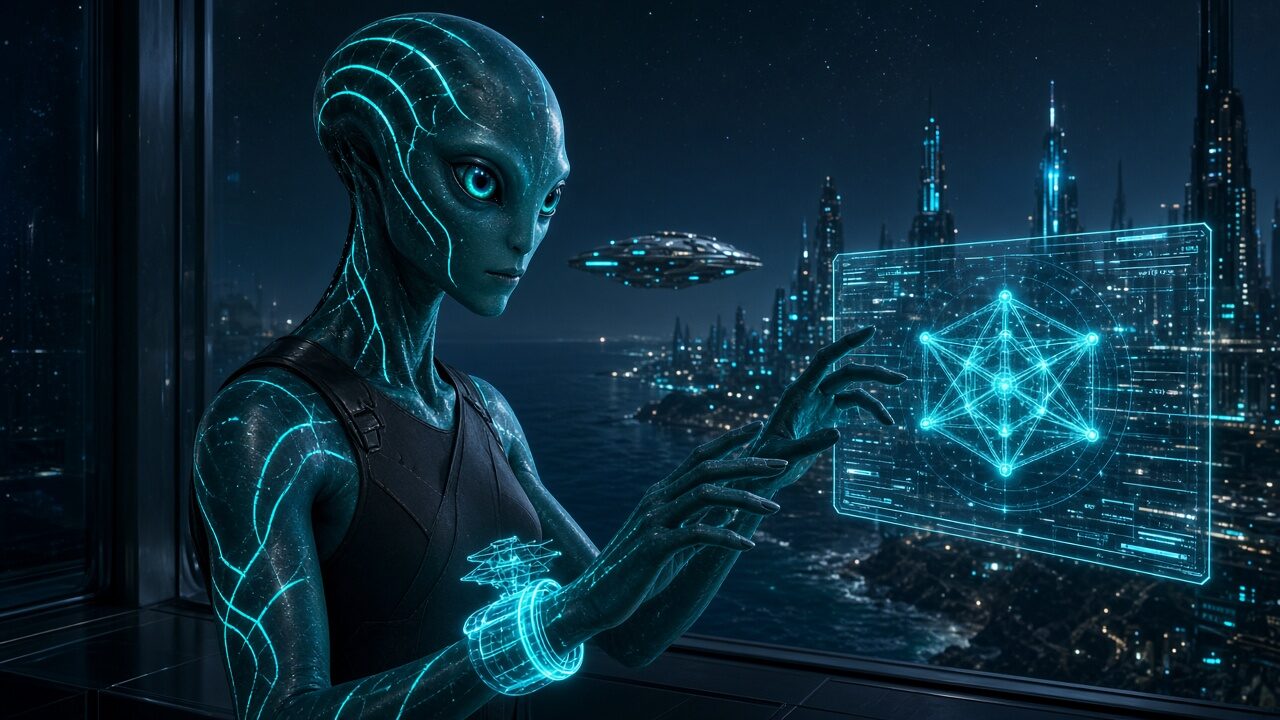
A Nethrai working a wrist-worn holo-lattice interface.
AI-generated illustrations of speculative worldbuilding, prompted from the seeded parameters. They are not photographs.
The quantum mission Real
- Processor
- Quantum Inspire Tuna-17, 17 superconducting qubits (real hardware)
- Jobs
- 1476056, 1476057, 1476062, 1476063, 1476068
- Ran
- 12:40 PM to 1:01 PM PT, Sep 26, 2026
- Quantum time
- 183.47 s of execution
- Shots
- 302,949
- GHZ-17 test
- 37.9% of shots were all-0 or all-1 (independent random bits would give 0.0015%)
- GHZ-5 test
- The 5 entangled qubits agreed in 80.8% of shots (random would give 6.25%)
- Mission seed
- de15ee79…8732
The GHZ results are population measurements, which are a strong correlation signature. Full entanglement fidelity was not measured.
The five jobs Real data
| Job | Circuit | Shots | Unique | QPU | Done (PT) |
|---|---|---|---|---|---|
| 1476056 | Hadamard on all 17 qubits | 8,192 | 7,928 | 7.55 s | 12:40:52 PM |
| 1476057 | GHZ-17 (tree) | 62,330 | 3,884 | 38.27 s | 12:41:35 PM |
| 1476062 | Random CZ layers | 87,345 | 37,269 | 52.91 s | 12:47:21 PM |
| 1476063 | GHZ-5 + 12 Hadamard | 118,294 | 26,005 | 64.73 s | 12:48:32 PM |
| 1476068 | Hadamard on all 17 qubits | 26,788 | 24,105 | 20.00 s | 1:01:19 PM |
Full seed: de15ee796ae4db64ef378fde7ca1275583f76462567316346620da2ab3ed8732
City: Qirport Speculative worldbuilding
In this story, Qirport is a terraced crescent city that follows the shoreline of a fjord coast at 20° south. Its 60.5 million people live among 4 arcologies and about 2,014 towers. A typical tower stands near 400 m, and the Glass Spire rises 2,013 m. Three sky districts are linked by skybridges between the arcology crowns. A 98 km elevated maglev loop, autonomous harbour ferries and a suborbital shuttle port connect the city to the equatorial space elevators.
Landmarks: the Starwater Promenade, a bioluminescent seawall; the Tuna Archive, a planetary data vault said in legend to hold the “first seed”; and Zenith Plaza, with the best view of the orbital ring.
Inhabitants: the Nethrai Speculative worldbuilding
The Nethrai are slender and long-limbed, about 1.93 m tall, with two arms and two digitigrade legs. Their skin is a smooth deep teal with a pearlescent sheen. Twin glowing cyan stripes run from brow to heel, and freckle-like glints dot the cheeks and shoulders. Large dark eyes with cyan-ringed irises are suited to Kestrel’s light and the long 13.3-hour nights.
They wear layered translucent robes woven from light-guiding fibre, and they use wrist-worn holo-lattices and personal grav-skiffs. Nethrai greet each other by synchronising glow pulses. Every night their cities hold the Glitter Tide, when millions of photophores flash in unison. They live about 159 years.
No real beings were observed or detected. The species is fiction generated from the mission seed.